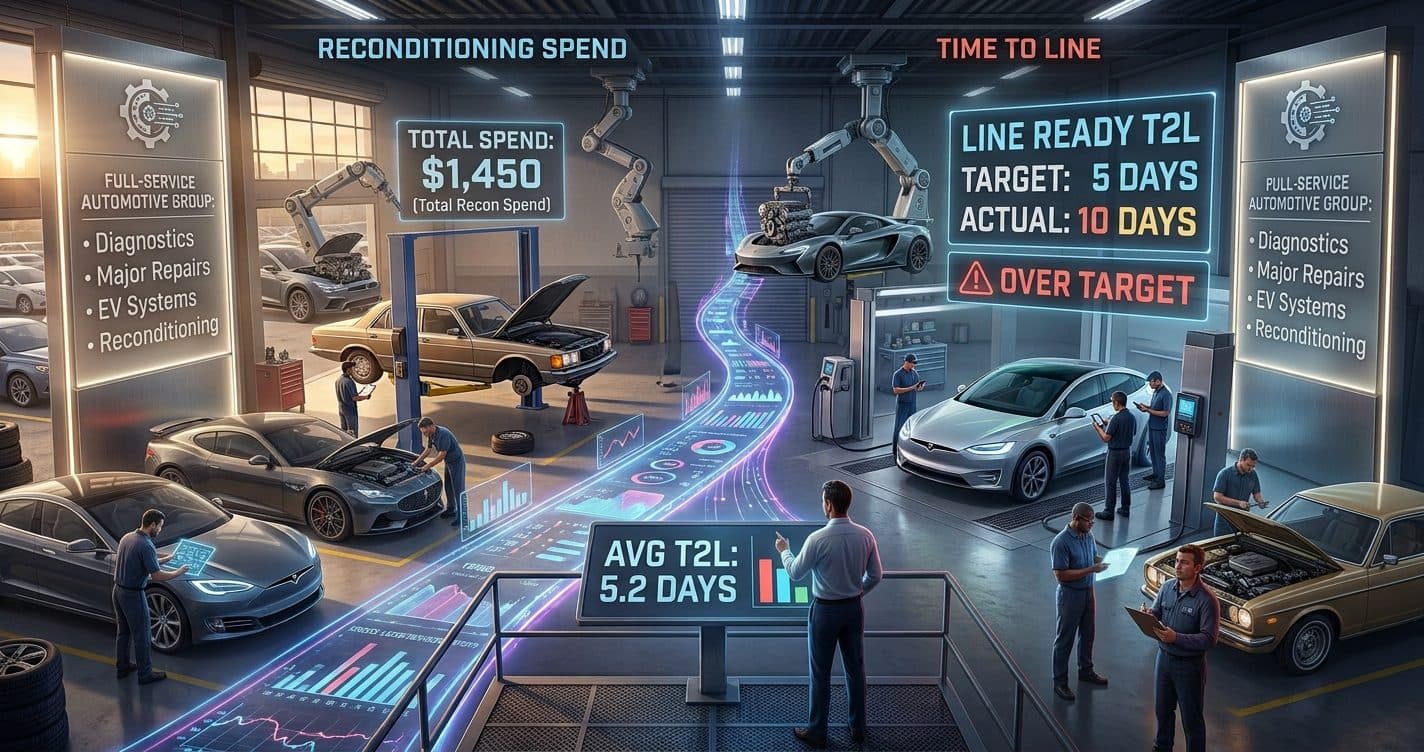
Between the moment a dealer acquires a vehicle and the moment it's photographed, priced, and live on the lot, that unit passes through inspection, repairs, tires, and detailing — and every dollar and every day spent in that process comes straight out of eventual gross. It's largely invisible to the shopper, and on too many lots, it's just as invisible to management.
Used car gross profit per unit was down double digits year-over-year in 2025 industry-wide, which makes recon one of the few levers dealers can still control directly rather than waiting on the market to cooperate.
Two Levers, Not One
Most dealers manage reconditioning spend and ignore reconditioning speed. Both matter, and they pull against each other in ways worth understanding.
Reconditioning spend is the dollar cost of the work itself — commonly running anywhere from a few hundred dollars for light cosmetic work up to $1,500 or more for moderate mechanical repairs, with dealership averages often landing around $1,000–$1,100 per vehicle depending on standards and vehicle condition.
Time to line (T2L) is the number of days from acquisition to the unit being front-line ready. Industry data consistently shows many dealers running a T2L of 7–10 days or longer — and every one of those days carries a real holding cost, commonly estimated between $40–$85 per vehicle per day once depreciation and carrying cost are factored in.
Here's the part that catches dealers off guard: spending more on recon doesn't necessarily buy more gross. If the retail ceiling on a vehicle is set by comparable listings rather than by how much polish went into it, over-investing in cosmetic work a budget buyer will never pay extra for can cut realized gross roughly in half compared to a disciplined recon spend on the same car.
Where the Days Actually Go
The frustrating reality on most lots is that reconditioning delay isn't spent working on the car — it's spent waiting on it. Common failure points include:
- Approval cycle time — how long it takes a manager to sign off on repair estimates
- Vendor idle time — gaps between when a vehicle leaves one stage and enters the next
- Parts ordering accuracy — the wrong part ordered the first time doubles the wait
- Supplement frequency — repeated additional estimates as issues are found piecemeal instead of upfront
- Rework — redoing work that wasn't done to standard the first time
None of these show up on a standard gross profit report. They only show up if someone is actively measuring time to line as its own metric, daily.
What High-Performing Dealers Are Doing Differently
High-performing dealer groups increasingly treat reconditioning as a managed production process rather than a series of disconnected vendor handoffs. In practice, that looks like:
- Tracking time-to-line by vehicle, not just in aggregate, so aging units are visible before they become a problem
- Setting a target T2L (commonly 4–5 days) and treating anything beyond it as an exception requiring explanation
- Calibrating recon spend to the vehicle's price segment — a $12,000 unit and a $30,000 unit shouldn't get the same reconditioning standard
- Making approval and vendor idle time visible daily rather than discovering the delay after the car has already cost real money sitting
The Bottom Line
Reconditioning is one of the few parts of the used car business a dealer fully controls — no market conditions, no rate environment, no consumer demand shift required to fix it. The dealers protecting gross in 2026 aren't necessarily buying better or pricing smarter. Often, they're just watching a process everyone else is letting run on autopilot.
Cost and timing figures cited reflect industry-reported ranges as of 2026 and vary by vehicle condition, region, and dealer standards.
Ready to modernize your dealership?
See how RevCore replaces your CRM, desking, F&I, and service tools with one platform.
Book a Demo