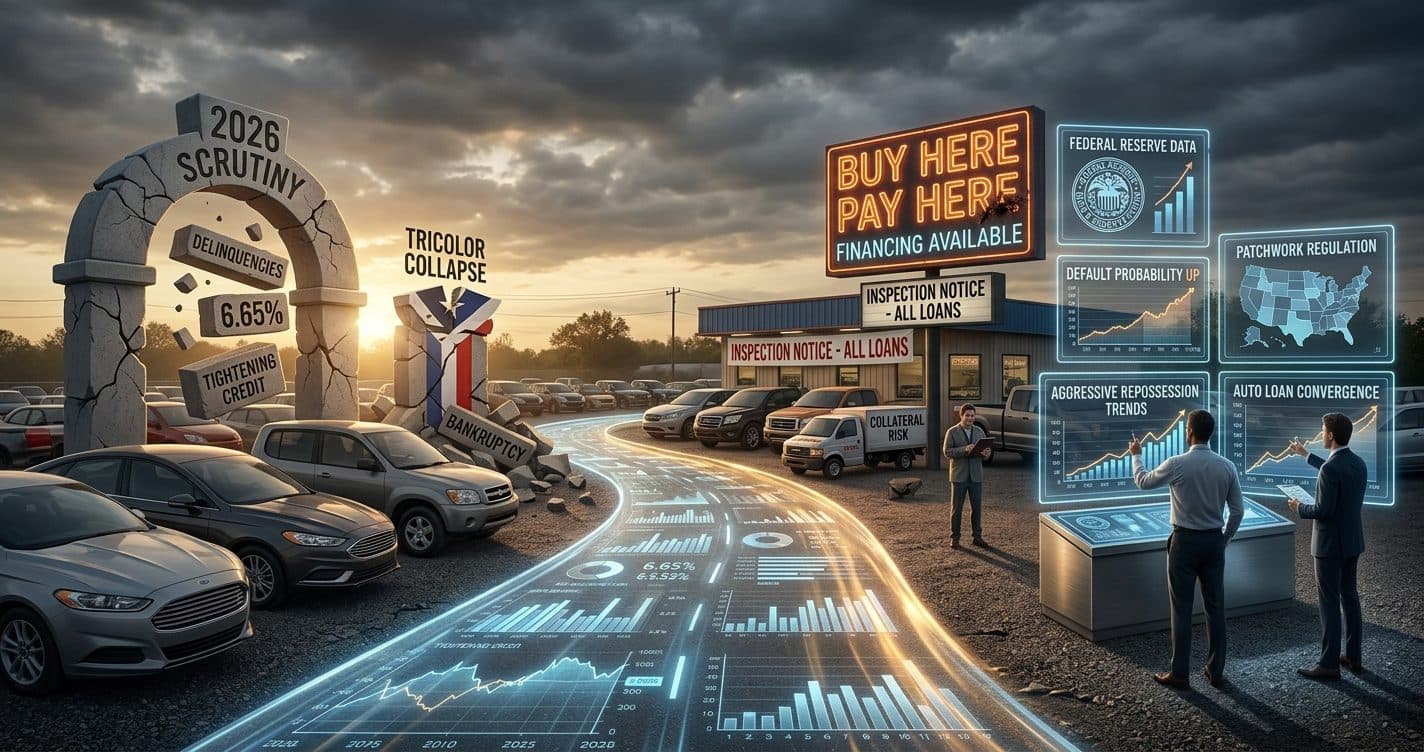
Buy here pay here dealers have always operated a different business than a standard used car lot — part retailer, part lender. That dual role is now facing more pressure than it has in years, driven by rising delinquencies, a high-profile industry collapse, and lawmakers paying closer attention than they have in a decade.
Delinquencies Are Climbing Fast
Subprime auto loan delinquency has been trending upward, with some tracking putting peak delinquency rates near 6.65% recently — a level that leaves little room for error in underwriting. Federal Reserve researchers have also found that risk metrics for BHPH-focused lenders have been converging with those of traditional auto lenders, with reported default probability on BHPH borrower loans climbing sharply in recent quarters.
That convergence matters. Part of what historically made the BHPH model work was that lenders treated it as its own risk category. As that gap closes, credit access for BHPH operators is tightening right alongside it.
The Tricolor Collapse Changed the Conversation
A major subprime BHPH lender's 2025 bankruptcy pulled back the curtain on practices — including aggressive repossession tactics in states with looser rules — that regulators and lawmakers had mostly overlooked. Since then, scrutiny of the sector has intensified, including new attention from Senate banking committee members specifically probing auto lending and repossession trends.
The practical effect for independent BHPH operators: banks have become more cautious about extending credit to the sector, and the days of BHPH being treated as a regulatory afterthought appear to be ending.
What This Means for How BHPH Dealers Operate
A few shifts are showing up across the industry:
Underwriting discipline is no longer optional. Loose approval standards that were tolerable when delinquency was low are a direct liability in the current environment. Clear, documented underwriting criteria — maximum loan terms, acceptable default thresholds, down payment minimums — are becoming table stakes rather than best practice.
Compliance requirements are tightening. New accounting and financial reporting expectations are pushing BHPH and used car dealers toward more rigorous, auditable systems, replacing manual reconciliation with something a lender or regulator can actually review cleanly.
Portfolio visibility matters more than volume. Operators managing their loan book with real-time data — payment status, insurance tracking, collateral risk — are better positioned than those relying on spreadsheets and manual follow-up, especially as regulatory reporting expectations rise.
State-level rules are getting more attention. Regulation of BHPH has historically been fragmented and state-by-state, with wide variation in repossession rules, interest rate caps, and licensing requirements. That patchwork is exactly what's now drawing legislative interest, meaning operators in looser-regulation states shouldn't assume that stays the case indefinitely.
The Bottom Line
The BHPH model isn't going away — it still serves a segment of buyers that traditional financing doesn't reach. But operating it the way it was run a decade ago, on relaxed underwriting and manual back-office processes, is a materially riskier bet in 2026 than it was even two or three years ago. The operators managing risk deliberately — tight underwriting, clean compliance, real visibility into their portfolio — are the ones positioned to keep operating comfortably as scrutiny increases.
Figures cited reflect Federal Reserve research and industry reporting as of early-to-mid 2026. Regulatory requirements vary significantly by state; consult counsel for compliance guidance specific to your operation.
Ready to modernize your dealership?
See how RevCore replaces your CRM, desking, F&I, and service tools with one platform.
Book a Demo